
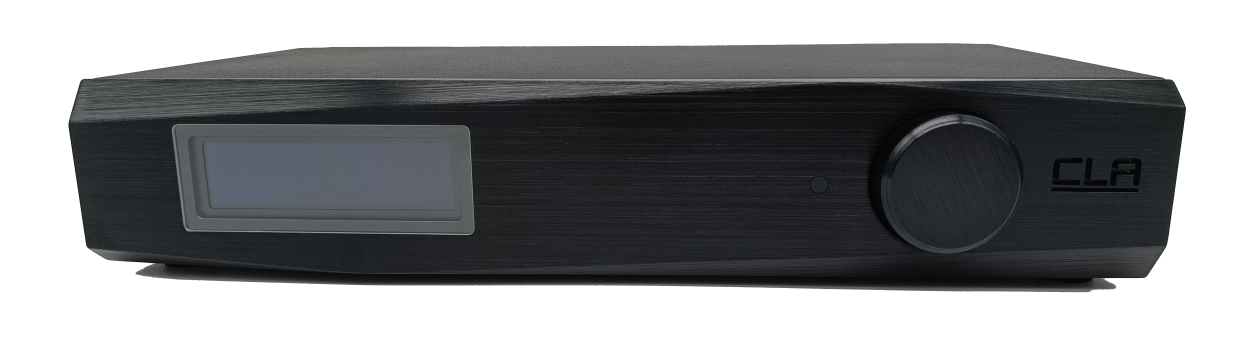

DSP-8C
8-channel digital signal processor
£1,495.00
Incl. shipping and VAT
Engineered for sound
The CoLinear Acoustics DSP-8C is a state-of-the-art multi-channel digital signal processor and preamplifier, purpose-built for advanced room correction, multi-way active crossovers, and speaker/driver alignment in both frequency and time domains. Designed for audio professionals, system integrators, and discerning enthusiasts who require precise control over their acoustic environment.
The DSP-8C accepts stereo input signals and processes them through high-resolution algorithms to provide eight independent output channels. Each channel offers comprehensive frequency response shaping, time domain correction, and gain management capabilities. The system is optimised for active speaker designs, room acoustic correction, and multi-driver integration where phase coherence and frequency response accuracy are critical.
Applications include development of active speaker systems, professional studio monitor optimisation, room correction in critical listening environments, and custom installation projects requiring precise acoustic control. The DSP-8C delivers the processing power and reference-grade performance necessary for the most demanding audio applications.

High-precision DSP engine
A 1GHz SHARC+ processor with inbuilt IIR and FIR accelerators delivers high-speed, low-latency digital signal processing. The internal DSP sampling rate can be set to either 96kHz or 192kHz, allowing up to 348 IIR biquads and over 53,000 combined FIR taps for detailed crossover design, correction, and time alignment across all channels.
Cross-platform control
DSPconfig, our intuitive control application, runs on Windows, macOS, and Linux. It offers a fast, visual interface with full access to all parameters, including comprehensive crossover and filter design, time alignment, gain structure, and output configuration.

Reference-grade DAC performance
Digital-to-analogue conversion is handled by the ES9039SPRO DAC with HyperStream IV architecture which feeds a carefully optimised analogue output stage. This combination yields class-leading results, with THD+N as low as -126 dB and dynamic range up to 130 dB (A-weighted). Each of the 8 output channels maintains exceptional linearity and low distortion across the entire frequency spectrum.

System integration
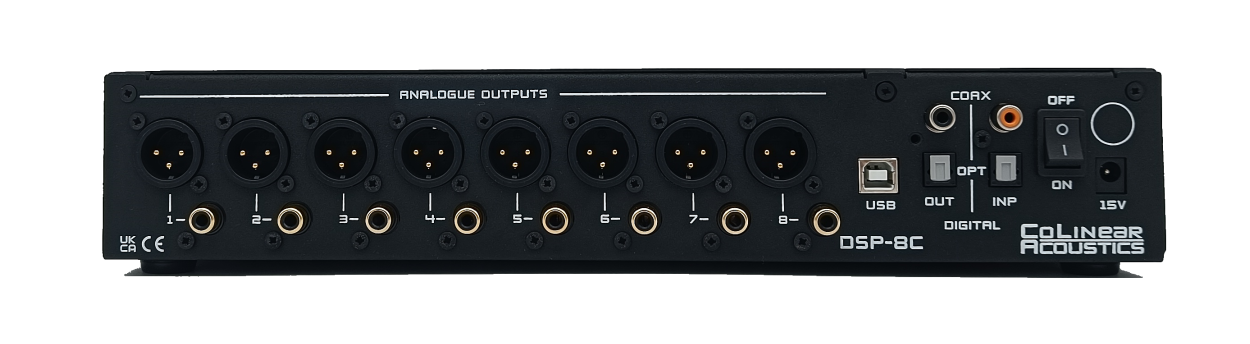
The DSP-8C offers user selectable calibrated full scale voltage output as well as independently configurable single-ended RCA or true balanced XLR outputs. This makes it highly versatile across different amplifiers and active speaker systems, whether in the studio, your hi-fi, or custom installs. Flexible input options include USB, S/PDIF coaxial, and optical connections supporting up to 24-bit / 192kHz resolution.
- Input / output channels
- 2 / 8
- Total harmonic distortion + noiseTHD + N
- Up to -126 dB1 / 0.00005%, unweightedUp to -126 dB1 / 0.00005%, unweighted
- Dynamic rangeDNR
- 130 dB1, A-weighted130 dB1, A-weighted
- Output impedanceZOUT
- 95 Ω (single-ended)190 Ω (balanced)95 Ω (unbal)190 Ω (bal)
- Full scale voltage outputFS VOUT
- 2.00 V to 2.50 V in 0.05 V steps (single-ended)4.00 V to 5.00 V in 0.10 V steps (balanced)2.00 – 2.50 V (0.05 V steps, unbalanced)4.00 – 5.00 V (0.10 V steps, balanced)
- Frequency responseFreq. resp.
- 20Hz – 20kHz +0.0 dB / -0.02 dB20Hz – 20kHz +0.0 dB / -0.02 dB
- Processing resolutionProcessing res.
- 32-bit floating point / up to 192kHz
- Processor
- 1 GHz 32-bit floating point SHARC+ architecture with inbuilt FIR and IIR accelerators
- Digital-to-analogue conversionDAC
- 8-channel ES9039SPRO DAC with HyperStream IV architecture
- Inputsall at up to 24 bit / 192kHzInputs
- 1 x USB audio (UAC2)1 x S/PDIF coaxial1 x S/PDIF optical1 x USB audio (UAC2)1 x S/PDIF coaxial1 x S/PDIF opticalall at up to 24 bit / 192kHz
- Outputs
- 8 x RCA, single-ended8 x XLR, balanced1 x S/PDIF coaxial1 x S/PDIF optical8 x RCA, unbal.8 x XLR, bal.1 x S/PDIF coaxial1 x S/PDIF optical
- IIR filters
- Input channels: up to 60 biquads, combinedOutput channels: up to 288 biquads, combined348 biquads
- FIR filters
- at 96kHzInput channels: up to 16,384 taps, combinedOutput channels: up to 36,864 taps, combinedat 192kHzInput channels: up to 9,216 taps, combinedOutput channels: up to 18,432 taps, combinedat 96kHz53,248 tapsat 192kHz27,648 taps
- Software control
- DSPconfigWindows/macOS/LinuxDSPconfig
- DimensionsDims
- 330 x 180 x 70 mm (W x D x H, overall)330 x 180 x 70 (mm, W x D x H)
- Weight
- 1.55 kg (net), 2.2 kg (gross)1.55 kg (net)2.2 kg (gross)
- AccessoriesIncluded
- 1 x infrared remote control1 x 22.5 W universal AC adapter1 x 2 m braided USB-A to USB-B cable1 x remote control1 x AC adapter1 x 1.5 m USB cable
- Compliance
- CE, UKCA, FCC Part 15 Class BConformity and disposalCE, UKCA, FCCDetails
After spending some time testing the DSP-8C, I can honestly say this unit feels incredibly serious the moment you take it out of the box. Sound quality is where the DSP-8C really stands out. The ES9039SPRO DAC combined with the OPA1612 output stage delivers a super clean and detailed presentation with huge dynamic range. Vocals sounded incredibly precise while bass remained tight and controlled even during more demanding tracks.
Modul KollektivView their full review on Instagram
Fantastic sound and easy DSP programming in an unpretentious box. It makes A/B testing very easy.
Ole, DenmarkDIY - Linear Dipole Array - Purifi mids, Mundorf AMT tweeters, SB-Audience subs
We are running it on a €300,000 system for a four way speaker system (Accuton drivers). So yes, it is good for serious listening. Pros: sound quality, quick response of software. Good chain of audio processing.
Christian, Germany4-way active Lyravox loudspeakers
Stunning sound precision, minimal background noise - ease of system setup and fine tuning. Uncompromised sound precision/quality that makes all the difference ! :)
ARBi-amped system (based on TAD 2404 eXclusive design). ARAI E-170 cabinet with TAD TL-1603, TAD TH-4003 horn replica with TAD TD-4002 driver. Acoustic phases sync target + convolution to eliminate excess phase (minimal phase listening goal)
A very powerful DSP and preamp that sounds great and brings the best out of your system. Snappy change of volume and fast change of profile with little delay makes voicing of speaker and comparing profiles easy.
Ralf, AustriaWiiM Pro Plus and/or notebook to CoLinear DSP-8C - various amps - various active self developed 2-way speakers and subs
A very high quality DSP with a very good performance/price ratio. Very transparent sound.
AnonymousDIY 2-way or 3-way system
The DSP chip's processing power, the quality of the DACs, and the simplicity of the software setup. I’ve tested several miniDSP models, and this one is in a completely different league. I’ve also had the chance to test a DEQX HDP-4, and I still think this one is a step or two above it. The system's core.
Jesús, SpainI use it with a pair of DIY 4-way speakers, featuring a 10-inch Scan-Speak woofer, 6.5-inch Scan-Speak midwoofer, along with a 3-inch dome midrange and a 1-inch tweeter from BliesMa. The entire system setup was configured using REW and rePhase.
This is probably the best device on the market in terms of combining a modern DSP architecture, a multichannel DAC, objectively excellent signal‑to‑noise performance, and other parameters that determine sound quality.
AleksCustom active speaker systems
The build quality is top notch and the specs. I'm reassured that it's more high end than miniDSP.
James, United Kingdom2-way wide-band assisted woofer system
Having FIR on all channels and on the inputs as well works really nice. Easy interaction with REW and rePhase. Balanced outputs is nice as well. Great DSP with full FIR support and low noise levels.
Douwe, Netherlands4-way open baffle speakers
The DAC chip is superior to any other speaker management system I have used in the past. The user interface is intuitive and powerful. A true high fidelity speaker management system. Simple yet powerful, with options for IIR and FIR filtering.
Mark, United States3-way Danley SH-50 speakers
5 stars. Positives: stability, DAC performance. DSP is the future, combine it with tube amps and you have it all, and by "tube", 300b-845 is the way.
Tasos, GreeceDIY speaker 4-way : Sub 2x10inch + 1x15inch Dayton UII -)(- Accuton C220 -)(- 2X Accuton C90 D'apol -)(- Mundorf D23 AMT
State of the art FIR DSP engine. Great sound quality. More taps than you need. Best sounding DSP I know with best hardware short of the mad Trinnov Altitude stuff which has downsides too.
William, United KingdomMulti-way active speaker system
What is the DSP-8C?
The DSP-8C is an 8-channel digital signal processor and preamplifier from CoLinear Acoustics, built for active loudspeaker crossovers, driver and room correction, and time alignment. It takes a stereo digital input over USB, S/PDIF coaxial or optical and processes it into eight independent analogue output channels, each with its own crossover, EQ, FIR filter, gain and delay. It costs £1,495 including UK shipping and VAT, and is configured from a computer with DSPconfig, our free application for Windows, macOS and Linux.
What is the difference between the DSP-8C and the DSP-4C?
The DSP-4C is the four-channel version of the same platform: the same 1GHz SHARC+ processor, the same FIR tap budget at 96kHz, the same DSPconfig software and the same analogue performance figures, with four output channels instead of eight and dual two-channel ES9039Q2M DACs in place of the DSP-8C's eight-channel ES9039SPRO. The DSP-8C suits a three-way or four-way stereo system, or a two-way system with subwoofers; the DSP-4C suits a two-way stereo system or a stereo pair with two subwoofers. The DSP-4C is £965, is open for pre-order and ships in November 2026 - see the DSP-4C page.
How does the DSP-8C compare with the miniDSP Flex Eight?
Both are two-in, eight-out processors for active systems, but the DSP-8C is specified for considerably higher analogue performance and processing capacity. Against the Flex Eight's published figures: THD+N of up to -126 dB against -111 dB, dynamic range of 130 dB(A) against 125 dB(A), a 1GHz SHARC+ against a 400MHz SHARC, processing at up to 192kHz against 96kHz, FIR filtering on every input and output channel (53,248 taps at 96kHz) against a stereo FIR bank on the inputs only (2 x 2,048 taps), and both RCA and balanced XLR outputs with adjustable level against RCA only. The Flex Eight offers Bluetooth input and an optional Dirac Live licence, which the DSP-8C does not. The full table is in DSP-8C vs miniDSP Flex Eight.
Does the DSP-8C do FIR filtering on every channel?
Yes. Every input and every output channel has its own FIR filter alongside its IIR crossover and EQ. At 96kHz the two input channels share up to 16,384 taps and the eight output channels share up to 36,864, a combined 53,248 taps; at 192kHz the figures are 9,216 and 18,432. A long filter on one channel is split across the FIR accelerator automatically, so the only ceiling on a single channel is the shared total. The FIR vs IIR article explains when each kind of filter is the right tool.
Can I use the DSP-8C for room correction?
Yes, through a measurement-led workflow. Measure with a tool such as REW, design the correction there or in rePhase, and import the resulting filters into DSPconfig: parametric EQ from REW's filter export, and FIR impulse responses from rePhase. DSPconfig does not currently include automatic room correction, and there is no Dirac Live licence; what you get instead is complete control over what is corrected and how.
Which software controls the DSP-8C, and which operating systems does it run on?
DSPconfig, our free control application, runs natively on Windows 11 (and some configurations of Windows 10), on macOS on both Apple silicon and Intel Macs, and on Linux with .deb and .rpm packages for Ubuntu 20.04+, Fedora and related distributions. It gives real-time control of every parameter: input and output routing, crossovers, EQ, FIR filters, gain, delay and the four profiles. Download it from the DSPconfig page, and read the Getting Started guide for a walkthrough.
Can I try DSPconfig before buying a unit?
Yes. DSPconfig has a Demo Mode that creates a virtual device, so you can learn the interface, plan a system and build a complete profile with no hardware connected. A profile built in Demo Mode can be exported to a file and imported onto a real unit later.
What inputs and outputs does the DSP-8C have?
Inputs: USB Audio Class 2, S/PDIF coaxial and S/PDIF optical, all accepting up to 24-bit / 192kHz PCM. Outputs: eight single-ended RCA and eight balanced XLR analogue outputs, selectable per channel in DSPconfig, plus S/PDIF coaxial and optical digital outputs. The full-scale output level is adjustable from 2.0 V to 2.5 V RMS single-ended and 4.0 V to 5.0 V RMS balanced, so the unit can be matched to a wide range of power amplifiers and active loudspeakers.
Does the DSP-8C have Bluetooth, Wi-Fi or a built-in streamer?
No, deliberately. Every Bluetooth codec is lossy, and a wireless transmitter inside the enclosure would degrade the analogue output stage the unit is built around. Play audio over USB from a computer, or connect a streamer of your choice to the S/PDIF coaxial or optical input.
Can the DSP-8C be used as a preamplifier?
Yes. It has a master volume control on the front-panel rotary encoder and on the supplied infrared remote, input selection, and four stored profiles that can be switched from the remote without a computer. For systems where something downstream handles volume, a fixed-volume mode holds the DAC at full scale. The remote uses the Philips RC-5 protocol, so universal remotes and control systems can drive the unit too; the command set is in the owner's manual.
Does the DSP-8C need a computer connected to work?
No. A computer is needed only to configure it. Once profiles are saved to the unit it runs standalone, and the remote or the front panel selects the input, the profile and the volume. The USB input can still be used for playback from a computer if you want.
What sample rates and resolution does it process at?
Each profile runs the DSP at either 96kHz or 192kHz, chosen in DSPconfig. Processing is 32-bit floating point throughout, with 40-bit precision on the input-channel filters where the SHARC+ architecture allows it. Running at 192kHz halves the FIR tap budget, which is why the sampling rate is the first choice to make when building a profile.
How many profiles does it hold, and can I switch between them for A/B comparison?
Four. Each profile is a complete configuration: crossovers, EQ and FIR filters, delays, gains, which socket each output uses, and whether the profile's audio goes to the analogue or the S/PDIF outputs. Profiles are switched from the remote or the front panel in a moment, which makes comparing two tunings of the same system straightforward.
How much delay is available for time alignment?
Up to 655.35 ms on any single output channel, from a pool of 1,600 ms shared across all outputs at 96kHz (800 ms at 192kHz). DSPconfig shows each delay as the equivalent distance at the speed of sound, which is the figure driver alignment is usually worked out in.
What is the warranty?
Every unit carries a 24-month guarantee against defects in materials or workmanship, covering repair or replacement with carriage paid in both directions. The guarantee belongs to the unit, so it transfers to a new owner for the remainder of the term. Your statutory consumer rights apply in addition. The full terms are in our Terms of Use.
Where do you ship, and what does shipping cost?
Shipping is included in the price. UK orders go by tracked Royal Mail, and the price includes VAT. We also ship to the EU, Norway, Iceland, Switzerland, the United States, Canada and a number of other European countries, usually by DHL; international orders are sent delivery duties unpaid, so import duties and local sales taxes are payable on receipt, and typically arrive within one to two weeks. The destination picker in the footer shows the price in your currency. See the Shipping Policy.
Can I return the DSP-8C if it is not right for me?
Yes. You can cancel for any reason up to 14 days after delivery and have a further 14 days to send the unit back, under the Consumer Contracts Regulations 2013; you pay the return postage in that case. A faulty unit is returned at our cost. The process is described in the Terms of Use.
Where is CoLinear Acoustics based, and where is the DSP-8C designed?
CoLinear Acoustics is a British company founded in 2024 and based in Fort William, Scotland. The DSP-8C is designed and engineered in the UK, and every output channel is hand-calibrated.